
Most AI prompts read like a to-do list. I handed one a business goal instead, with clear limits and a finish line, and got back a full Black Friday campaign plus an honest list of what it couldn’t do.
Ask most people how they prompt AI and you’ll hear some version of the same routine. Write me an email. Make it shorter. Add a subject line. Try a different opening.
It works, sort of. But you end up doing all the strategic thinking yourself and using AI as a very fast typist.
I wanted to see what happens when you flip that around. So I gave AI a real job: plan and build a Black Friday campaign that takes a shopper from browsing to buying. I didn’t tell it how. I told it what I wanted, what it wasn’t allowed to do, and what finished would look like.
One prompt. Here’s how I structured it and what came back.
The Setup
A fictional brand and a single brief
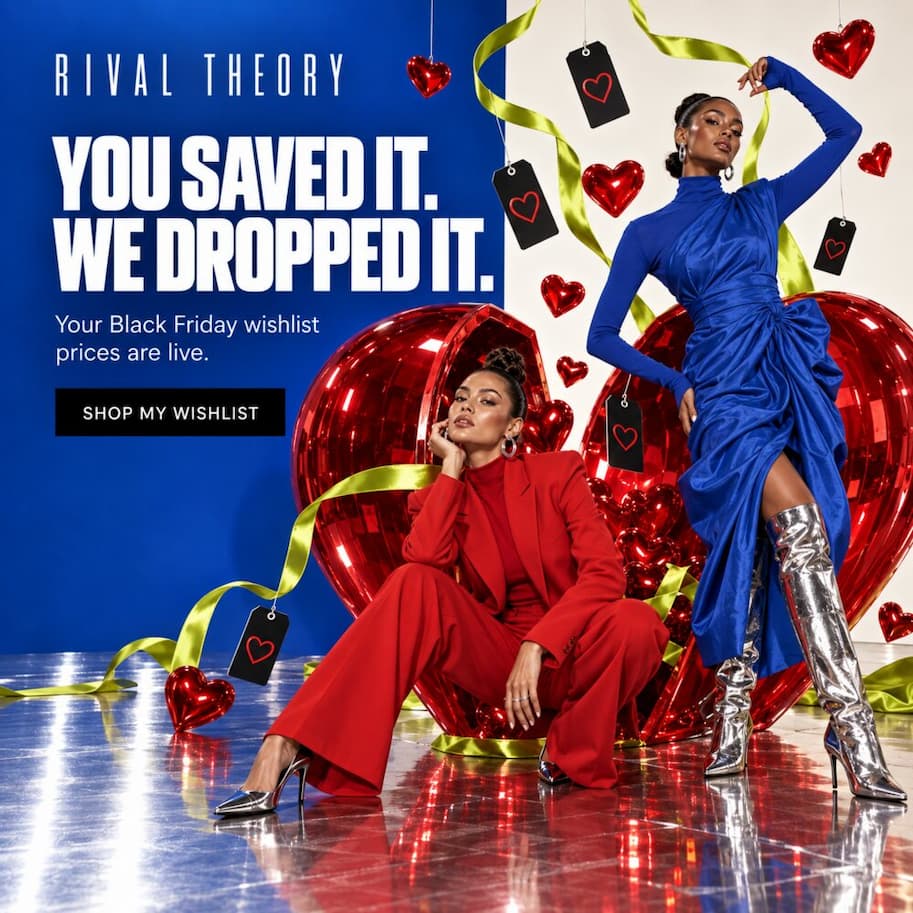
The test brand is Rival Theory, a fashion label we made up purely for this exercise. That matters. Nothing below is a performance claim, and there are no sales figures here. This is about the process and the quality of what the AI produced.
From one prompt, it delivered a draft landing page in Shopify, a launch email, four Instagram posts, a campaign deck and a written report on everything it couldn’t verify. That last item turned out to be the most useful thing in the pile.
The Campaign
Your wishlist. Our bill.
The concept is simple. In the lead-up to the sale, shoppers build a wishlist on the site for the chance to win everything on it.
Think about what that does for a brand. Customers get a reason to browse weeks before the sale starts, and the brand gets a clear read on what people actually want. Then when Black Friday arrives, the discount lands on products each shopper has already picked out. That’s about as personal as a sale gets.
It runs in three stages.
01 · Build intent early
Invite shoppers to start a wishlist and enter the draw to win it all.

02 · Keep the list growing
Anticipation-led creative nudges shoppers to save more favourites, without giving the discount away too early.

03 · Reveal the personal price drop
When the sale goes live, send shoppers straight back to the items they saved.
Before the sale Shoppers have a reason to browse and save. The discount stays under wraps. | When the sale launches The offer is relevant straight away, because it points at products the shopper already chose. |
The Prompt
Five parts of a goal-based brief
In my experience, the newer models don’t need walking through every step. They do far better when you tell them the outcome you’re after, the lines they can’t cross and the point at which they’re finished. This is the structure I used.
01 · Goal
Describe the outcome you want. For this test, that was the full Black Friday wishlist campaign: landing page, launch email, four Instagram posts and a deck.
02 · Role
Tell it who it’s working as. I asked for a strategist, copywriter, art director and Shopify developer in one.
03 · Task
Lay out the work and the standard you expect. Research the brand first, then work through concept, copy, page, email, social and deck, and finish with a self-check.
04 · Guardrails
Spell out what’s off limits. No invented discounts, products or stock claims. Nothing gets published, and nothing gets sent.
05 · Done
Define finished. Every file delivered and tested on mobile and desktop, with a report on anything that failed.
The line most people leave out
“Work autonomously. Don’t ask me questions. Make sensible assumptions, record them and keep going.”
That line is about momentum. Instead of stopping at every fork to check in with you, the AI makes a call, writes down its reasoning and moves on. You review those assumptions at the end, all in one place.
Here’s how the two approaches compare in practice.
| Step-by-step prompting | Goal-based prompting |
|---|---|
| You plan the sequence and feed it in one piece at a time. | The AI plans the sequence from the outcome you describe. |
| You judge each output as it arrives. | It checks its own work against your definition of done. |
| Gaps are easy to miss until something breaks. | Gaps come back to you as a written list. |
Defining Done
Tell it exactly what finished means
Most prompts skip this part entirely, and it’s the one doing the heavy lifting. Here’s the closing section of my prompt, word for word.
Done
Deliver the hidden Shopify page and real preview URL; the launch email; four final PNGs with matching captions; the campaign deck; the brand brief, copy and self-check report. If something is blocked, complete and test the local files and state precisely what remains blocked.
Look at that second sentence. I expected parts of the job to get blocked, so I told it what to do when that happened: finish everything it could, test it locally and be precise about what was left.
The Output
What came back, and what got flagged
| Deliverable | Status |
|---|---|
| Hidden draft landing page in Shopify | Done. Built and left unpublished. |
| A real preview URL | Flagged. Shopify blocked it, so the files were labelled as local instead of a link being made up. |
| Klaviyo-ready launch email | Done. The offer is left as a marked placeholder. |
| Four 1080 × 1350 Instagram images with captions | Done. |
| Ten-page campaign deck | Done. |
| Brand brief, full copy and a self-check report | Done. |
| Mobile speed score of 90 or above | Flagged. The test errored, so no score was claimed. |
| Offer, theme install and store timezone | Flagged. Left for a person to confirm. |
Why It Matters
The flags are the point
It’s tempting to read that table and count the wins. I’d look at the flags first.
Because I’d spelled out what done looked like, the AI had something to measure itself against. When it fell short, it told me. It didn’t paper over the missing preview link or invent a speed score to tick the box. If you’re running campaigns with real customers and real revenue behind them, that honesty is worth more than any single piece of copy.
None of this takes a person out of the process. Someone still signs off prices, claims, links and mobile layouts before anything goes live. What shifts is where that person spends their time. They’re reviewing a finished campaign and a clear list of open questions, rather than building every piece by hand.
Great AI output rarely starts with a clever sentence. It starts with a clear goal, the right context and a definition of done.
Where To Start
Write the goal before the steps
If a big sale is on your calendar, the brief is the part to start early. A goal-based prompt can produce a campaign quickly, but you still need time to work through the flags, lock in offers and test everything properly before launch day.
Next time you open an AI tool, resist the urge to list the steps. Write down the outcome, the guardrails and what finished looks like. Then let it work.
Want help writing briefs like this for your own brand’s peak season? Get in touch with the Tribe Gen AI team and we’ll build it out with you.
Rival Theory is a fictional brand created by Tribe Gen AI for demonstration purposes. No campaign performance or sales results are claimed.